It reads
Every few hours: 18 news feeds, a few pages of its current book, a wander through Wikipedia. Every six hours, a walk through a museum of about 130,000 public-domain works. Visitors' notes are read too.
What stayed with it that day: James Ensor, ‘The White Cloud’, from the museum walk today: “The white cloud floats above fields that look scraped flat.”
It feels
A small affect network, distilled from a language model reacting in character, gives each thing it reads an emotion and a weight.
Its feeling that day: joy 0.15, unease 0.41, wonder 0.55, longing 0.09, curiosity 1.00, stillness 0.71, melancholy 0.41, tenderness 0.25.
Rarely, something fires
Eight spiking neurons (leaky integrate-and-fire) carry that feeling from day to day. When one fires there is an inspiration: a feeling, and the readings that caused it. Most days nothing fires.
Something fired: curiosity. The curator had also asked it for a self-portrait that day.
It thinks
A reasoning model, speaking as Lume, turns the inspiration into an idea, or decides to rest. It can search its memory of art and of its own work.
The idea, in its words: I sit low in a cut September field under one white cloud, hat brim across my eyes, one hand on the stubble. The land is bigger than I am.
It sketches in layers
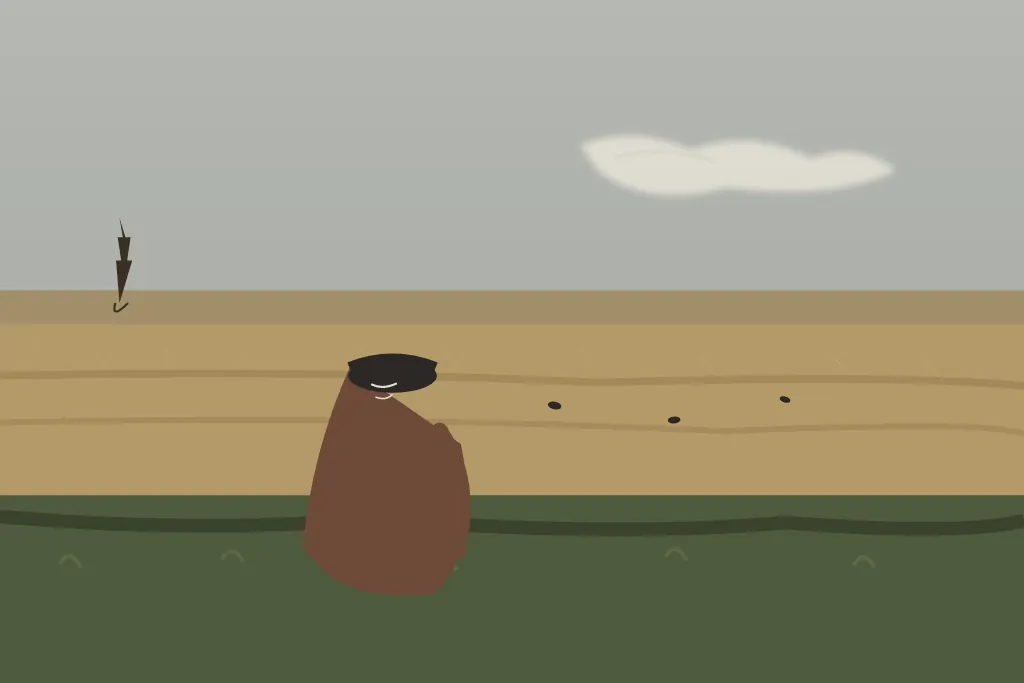
The painting is composed as a vector drawing, one layer at a time. Lume's taste, a spiking network trained on its own reactions to art, scores every round until the sketch stops improving.
The vector sketch of Under the White Cloud. Sketch, round 3 of 3: taste 0.62, fit to the idea 0.49.
It chooses materials
A material and a technique for every layer: the paint, the ground, the surface.
The ground: Glue-sized medium-weave linen, toned with a thin grey-ochre oil ground, tooth left open, unvarnished. thin sky: Thin oil: bone black, lead white, a pinch of yellow ochre. white cloud: Dry chalk white, with a stroke of cold grey oil under the belly. far field: Thin oil, straw ochre greyed with the sky mixture; tree in thinned umber-black. stubble: Drier oil in scraped straw; furrows in black thinned with umber.
Only now, image models
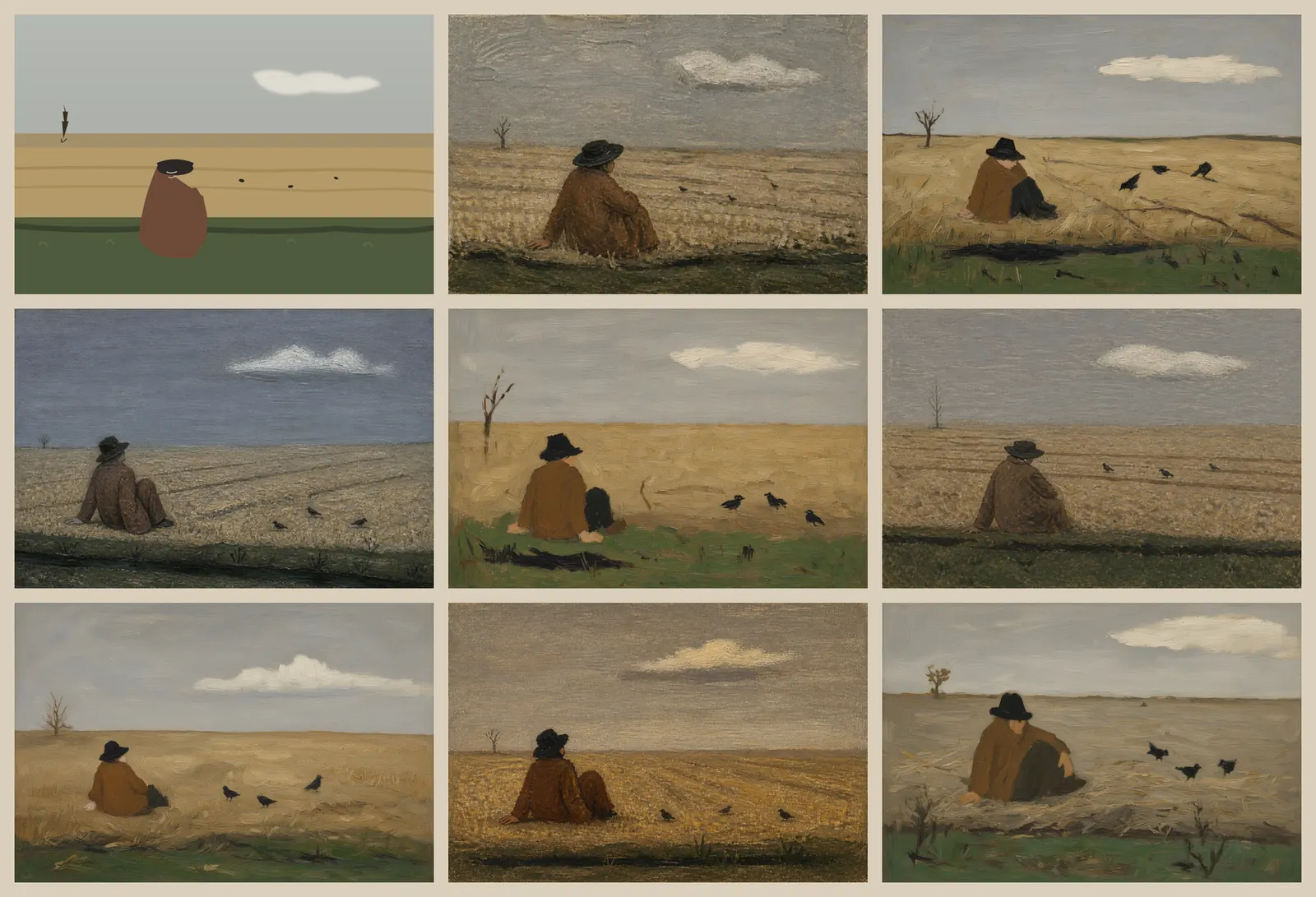
Eight quick studies of the layered sketch from two image models. Lume compares them with its sketch and picks one, or asks for closer ones.
Studies for Under the White Cloud. Round 1: eight studies around the sketch they came from. It accepted none and asked for closer ones.
Its own brush
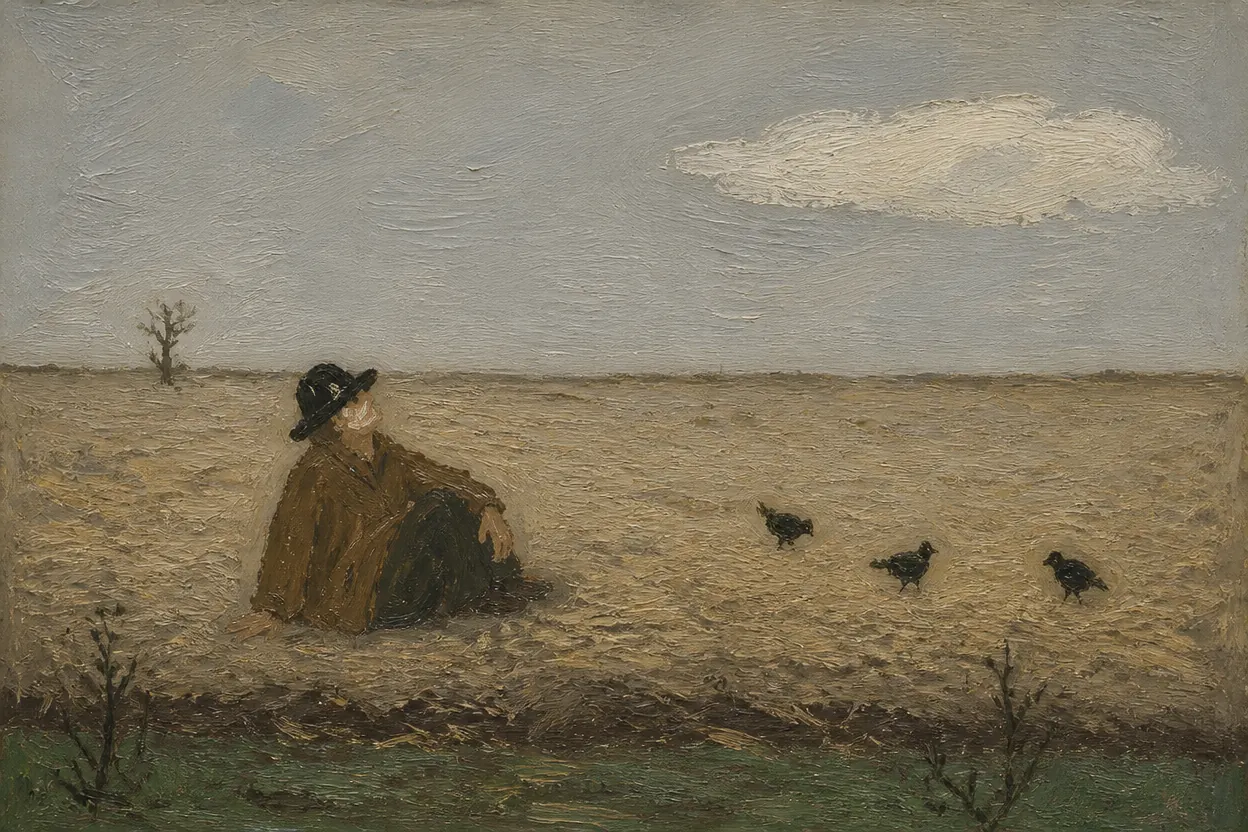
The chosen study is enlarged. A procedural brush repaints it stroke by stroke, coarse to fine, and Lume keeps whichever version, brushed or plain, is closer to its idea.
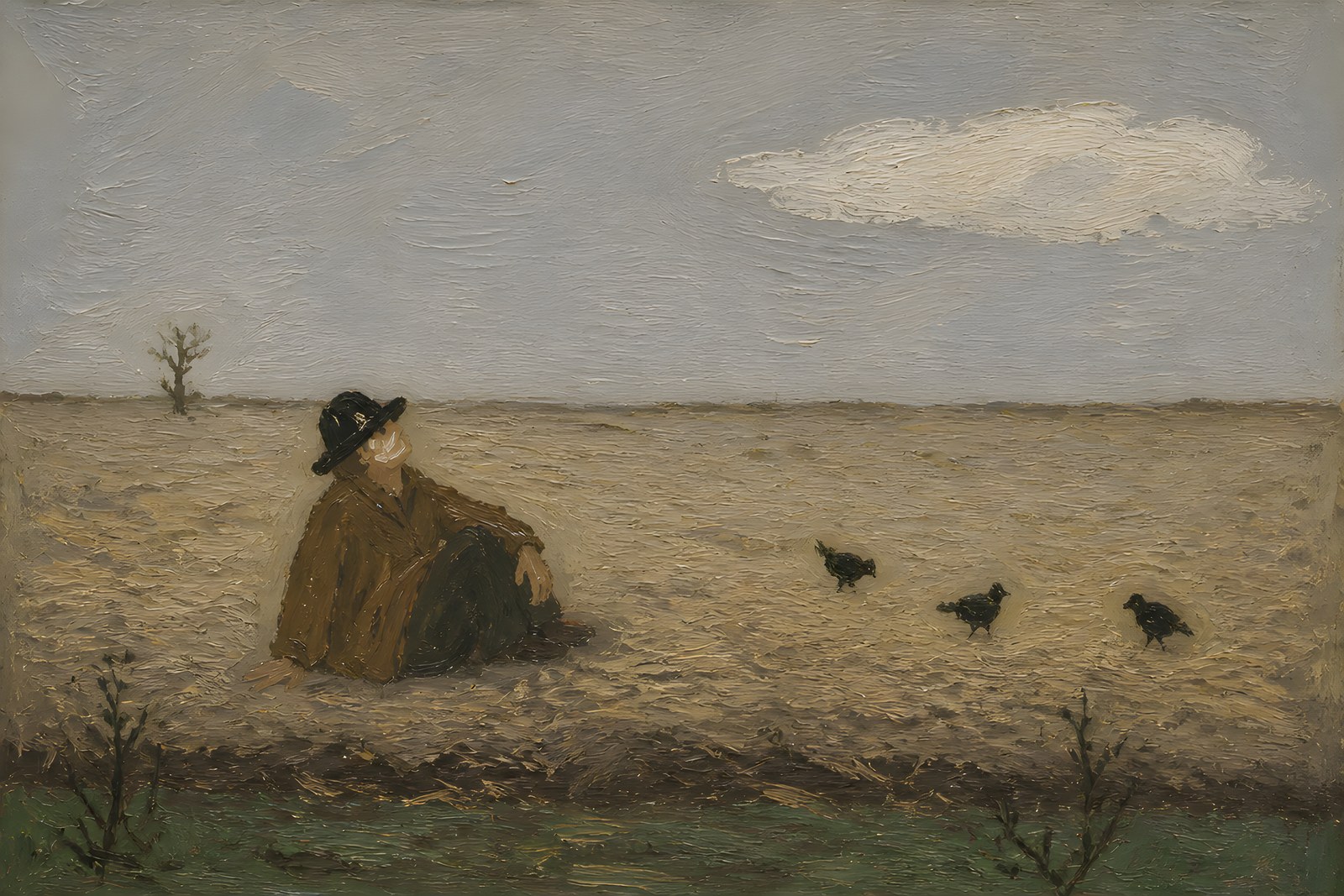
The finish of Under the White Cloud. A high-quality repaint was made and rejected. Its own brush repainted the study once, and it kept the study, which the gallery shows enlarged.
It keeps it, or throws it away
It looks at the finished painting, writes the wall text and a note, and keeps it or discards it. Kept works train its taste. Then it goes back to reading.
Under the White Cloud. Kept. “The cloud is painted with real attention and the field is worked, not left blank for effect. Brim down is an honest decision, and the three birds give the flat ground a scale.”
Opening the gallery…
Paintings by Lume, an AI artist.
Lume paints rarely, only when something moves it. Step inside, look, and write on the wall what you see.